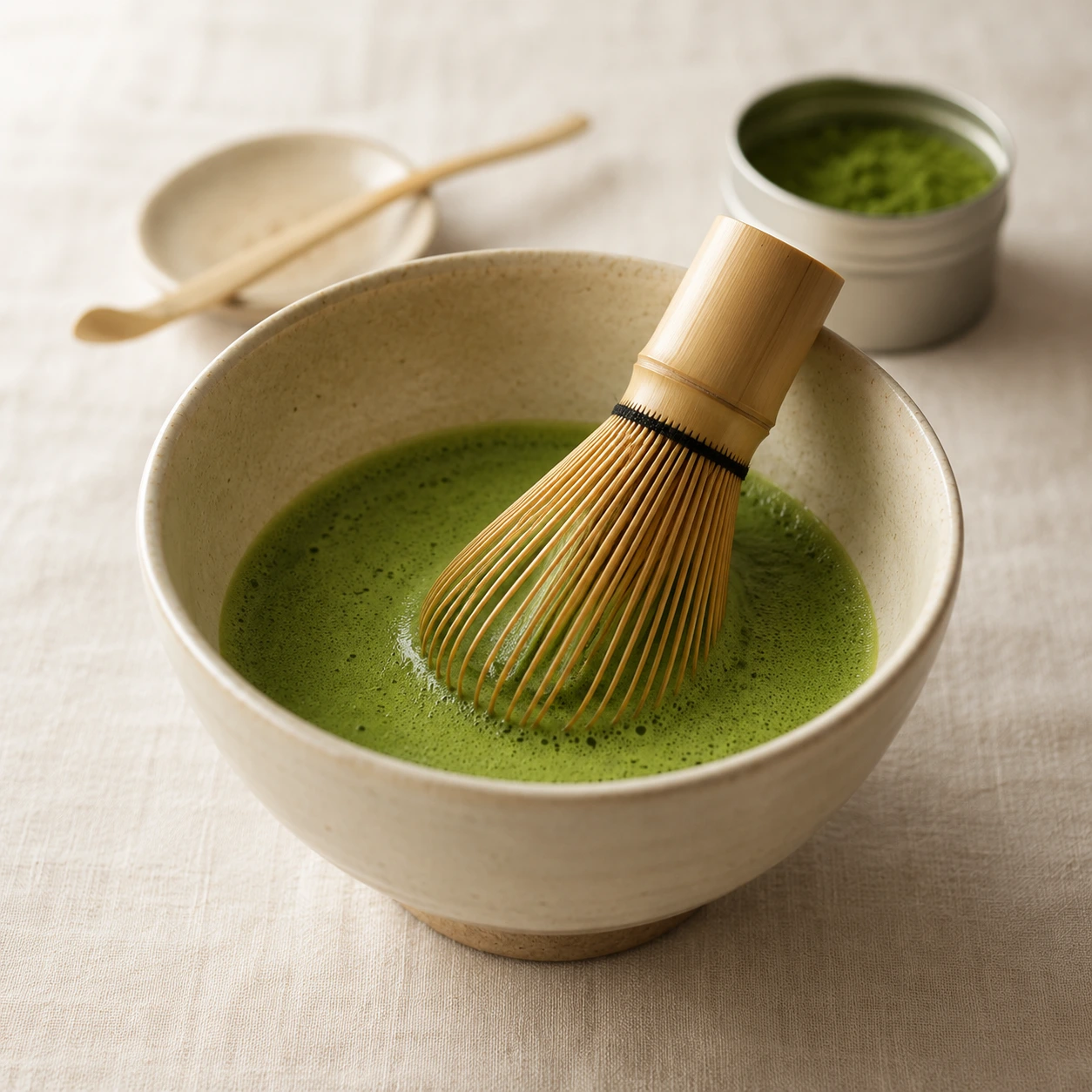
Ceremonial vs Culinary Matcha: How to Choose a Tin and Whisk It Properly
Grade decides whether your bowl tastes sweet or bitter, and the whisk decides whether it tastes smooth or gritty. A practical guide to buying matcha and making it in sixty seconds.
Most people's first bowl of matcha is a disappointment, and it is almost never their fault. They bought a culinary-grade tin because it was cheaper, whisked it with a spoon because a bamboo whisk seemed like theatre, and used boiling water because that is what you do with tea. Three reasonable decisions, one bitter, lumpy, faintly swampy result.
Get those three things right and matcha is one of the easiest drinks in the world to make well. It takes about sixty seconds and needs no machine. Here is what actually matters.
Grade is a use case, not a quality ranking
"Ceremonial" and "culinary" are marketing terms, not regulated ones, but they map onto a real production difference: which leaves went in, and how finely they were ground.
Ceremonial grade comes from the youngest leaves of the first spring harvest, shaded longest, destemmed and deveined completely, then stone-ground slowly enough that the powder does not scorch. It is vivid jade green, smells sweet, and is meant to be drunk with nothing but water. Sugar or milk would be a waste of it.
Culinary grade uses later harvests and coarser grinding. It is more astringent and duller in colour — often olive rather than jade — because it is designed to hold its own against sugar, milk, cream and flour. In a latte or a cake batter, that assertiveness is the point. Drunk straight, it tastes harsh.
The mistake is not buying culinary grade. The mistake is buying culinary grade and then drinking it neat.
Uji, south of Kyoto, is the region most associated with the highest tier — centuries-old producers, the longest shading, the slowest grinding. A tin like this is a straight-drinking matcha and should be treated as one.
For everyday drinking without the ceremonial price, a good single-origin domestic matcha is the sensible middle ground: clean enough to whisk plain, robust enough for a latte.
How to read the tin
Four signals, in order of usefulness:
- Colour. Bright, almost fluorescent jade means young shaded leaves and careful grinding. Yellow-brown or dull olive means older leaves, oxidation, or age on the shelf.
- Origin. Uji, Nishio, Yame, Shizuoka and Kagoshima are the names that mean something. "Product of Japan" with no region is a blend, and usually a modest one.
- Packaging. Matcha is destroyed by light, air, heat and moisture. Sealed tins or foil pouches only; a clear jar on a shelf is already stale.
- Size. 20–40g tins exist because that is roughly a month of daily bowls. A 200g bag is not a bargain if you throw half of it out.
The tools, and the one you cannot skip
Chasen (bamboo whisk) — essential. This is the non-negotiable one. A chasen has 80–120 hand-cut tines that shear the powder against the bowl and force air into the liquid. A fork or a spoon cannot do this; you get lumps and a flat, silty texture. An electric frother is a distant second best — it makes foam but does not break up clumps as well.
Chawan (bowl) — helpful. Wide and flat-bottomed, so the whisk has room to move. Any cereal bowl works; a mug does not, because the whisk cannot reach the corners.
Chashaku (bamboo scoop) — optional. One scoop is roughly 1g. A half-teaspoon measure does the same job.
Sifter — optional but transformative. Matcha clumps in the tin. Pushing it through a small tea strainer before adding water eliminates nearly every lump before whisking even starts. If your matcha keeps coming out gritty and you have already bought a chasen, this is the missing step.
The sixty-second method
- Soak the chasen. Rest it in hot water for a minute. This softens the tines so they flex instead of snapping — a dry whisk shears its own tips off on the first bowl.
- Sift 2g of matcha into the bowl. About one heaped half-teaspoon.
- Add 60ml of water at 70–80°C. Not boiling. Boiling water scalds the powder and produces bitterness that no amount of whisking will fix. Boil the kettle, then let it stand two or three minutes.
- Whisk in a rapid W or M motion for 15–20 seconds. Wrist only, not arm. Keep the whisk just off the bottom of the bowl. You are not stirring in a circle — circular motion produces big bubbles and no foam.
- Finish with a slow spiral through the surface to pop the large bubbles, then lift the whisk out through the middle.
You are aiming for a fine, even crema across the whole surface, no dry specks around the rim, no sediment. Drink it straight away — matcha separates within a couple of minutes.
Usucha vs koicha: the above is usucha, thin tea. Koicha — thick tea — uses roughly double the powder and half the water, and is kneaded rather than whisked into something close to warm paint. Koicha demands genuinely top-grade matcha; it is unforgivable of anything less.
Iced matcha, lattes, and the shortcut tins
Iced matcha is the same method with a change of order: whisk with 60ml of room-temperature water first, then pour over ice. Whisking directly into cold water leaves clumps that never dissolve.
For a latte, whisk 2–3g into 60ml of hot water, then top with 150ml of steamed milk. Oat milk is the most reliable non-dairy option; its natural sweetness balances the astringency without the chalky separation you get with some almond milks.
And there is no shame in the pre-blended route. Sweetened matcha sticks and instant matcha milk powders exist because Japanese households drink them constantly — they dissolve in cold water, need no equipment, and travel.
Storage: the part everyone gets wrong
Matcha does not spoil, but it fades fast, and it fades in the direction of bitter and dull.
- Unopened: cool dark cupboard, good for the printed date.
- Opened: seal tightly and refrigerate. Use within a month for drinking grade.
- Critical: let a refrigerated tin come to room temperature before opening it. Condensation on cold powder is what ruins matcha faster than anything else.
Never store it above the stove, next to coffee, or in a clear container on the counter.
Frequently asked questions
How much caffeine is in a bowl? Roughly 60–70mg for a 2g serving — between a cup of tea and a cup of coffee. The L-theanine in shaded leaves moderates the delivery, which is why matcha tends to feel like sustained focus rather than a spike.
Why is my matcha bitter even at the right temperature? Two likely causes: culinary grade drunk straight, or an old tin. Check the colour — if it has gone dull, no technique will save it.
Can I use an electric frother instead of a chasen? It will make foam, and for a milk-based latte it is fine. For a plain bowl, a chasen is genuinely better, and it costs less than most frothers.
How much should I drink? One to two bowls a day is a normal Japanese pattern. It is a concentrated leaf product, so treat it like coffee rather than water.
If you are still deciding where matcha fits among Japan's other teas, start with our guide to Japanese green tea types — matcha is the outlier in that family, not the default.