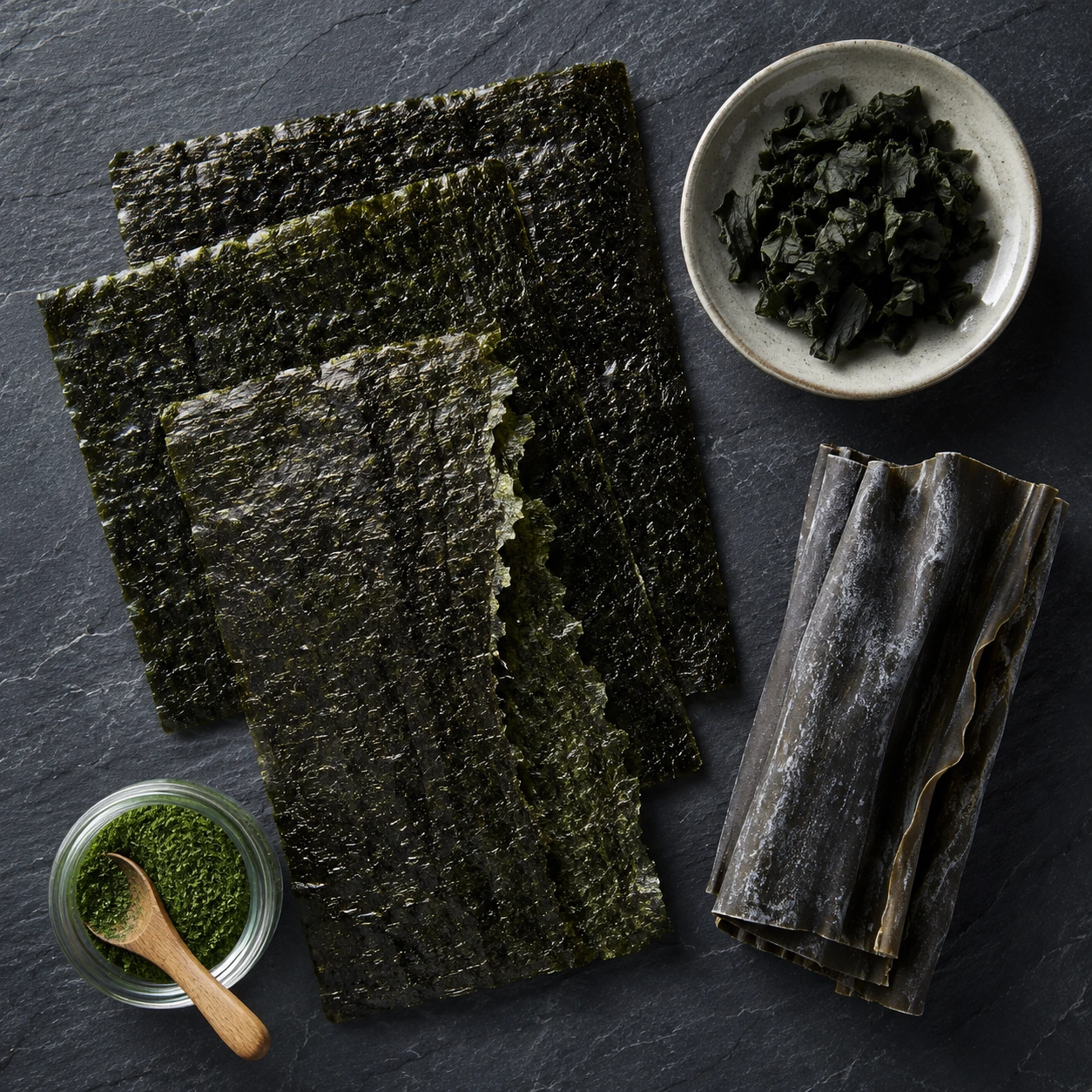
Nori, Wakame and Kombu: A Guide to Japanese Seaweed
Yaki nori or ajitsuke? Which seaweed makes stock, which makes snacks, and how to keep a sheet of nori crisp after you open the bag.
Seaweed is doing three completely different jobs in a Japanese kitchen, and most shoppers abroad only know one of them. It is a wrapper, a stock ingredient, and a seasoning — and the products for each are not interchangeable. Buying seasoned snack nori and trying to make sushi with it, or boiling kombu as though it were a bay leaf, produces results that make people quietly decide they don't like seaweed.
Sorted properly, it is one of the cheapest and most useful shelves in the shop.
Nori: the sheet, and the two kinds of it
Nori is cultivated red algae, shredded into a slurry and dried into sheets like paper. A standard full sheet is roughly 21 × 19 cm, and packs are labelled by how that sheet has been cut — 1/2, 1/3, 1/6, or 8-kire (eight-cut) strips for rice bowls.
The critical distinction on the shelf:
| Japanese | Reading | What it is |
|---|---|---|
| 焼き海苔 | yaki nori | Plain roasted. Nothing added. For sushi, onigiri, cooking |
| 味付け海苔 | ajitsuke nori | Seasoned with soy, mirin and sweetener. Eaten as-is with rice |
| 青のり | aonori | A different species, dried and powdered. A finishing seasoning |
| きざみ海苔 | kizami nori | Pre-shredded into fine strips for topping |
Yaki nori is what you want for anything constructed — maki, temaki, onigiri. It has no flavour of its own beyond toasted sea, so it supports rice and fish rather than competing with them.
Grade shows up as thickness, evenness and gloss. Good yaki nori is near-black with a green-blue sheen, dissolves cleanly on the tongue, and tears without shattering. Cheap nori is brown-flecked, brittle and leathery when it meets moisture.
Ajitsuke nori is a finished food, not an ingredient. The classic use is the simplest meal in Japan: hot rice, a seasoned sheet wrapped around a mouthful, repeat. Do not build sushi with it — the sweet soy glaze fights everything.
Onigiri sheets are the same seasoned family, cut and selected for wrapping a rice ball — this kind is seasoned with a blend of prawn, bonito, kombu and scallop dashi rather than plain soy, so the wrapper is doing some of the seasoning for you.
Aonori is a green powder from an entirely different algae, and it is the smell you associate with okonomiyaki and takoyaki. A pinch over yakisoba or fried noodles adds an unmistakable sea-and-grass note. It is used by the teaspoon, so one small jar lasts a very long time.
Kombu: stock, not a vegetable
Kombu is thick brown kelp, dried until leathery, and it is the vegetarian half of dashi — the stock under most Japanese cooking.
The rules are short and they matter:
- Do not wash off the white powder. That surface bloom is mannitol and glutamates — it is the flavour, not dirt or mould. Wipe with a dry cloth if anything.
- Do not boil it hard. Soak in cold water for 30 minutes, heat slowly, and pull the kombu out just as the water reaches a simmer. Boiled kombu turns the stock slimy and faintly bitter.
- Do not throw it away. Used kombu can be simmered in soy and mirin into tsukudani, or sliced into a salad.
Shio kombu — kombu simmered in soy and dried with salt — is the cheat code version. It is not for stock; it is a seasoning you scatter directly. Stir it through hot rice, toss it with cucumber and sesame oil for a two-minute side dish, or fold it into pasta with butter. It carries enough salt and glutamate to season a dish by itself.
One health note worth knowing: kombu is exceptionally high in iodine — far higher than nori or wakame. As an occasional stock ingredient it is fine, but daily large quantities are not advisable, particularly for anyone with thyroid conditions. Nori and wakame carry a fraction of the amount.
Wakame: the one in the soup
Wakame is the soft, dark green seaweed in miso soup and in the cold sunomono salad with cucumber and vinegar. It is sold dried and expands dramatically — five to ten times its dry volume — so a teaspoon per bowl is plenty. Rehydrate in cold water for about five minutes, drain, and add at the end; it needs no cooking.
It is worth keeping a bag purely because it upgrades instant soup. A pinch of dried wakame in any instant miso sachet makes it taste considerably more like something made in a kitchen.
Seaweed as a snack
Japan snacks on nori, and the format is much better than it sounds to anyone who has not tried it.
Snack-format seasoned nori is processed for a deliberately noisy, brittle crunch rather than the soft fold of a sushi wrapper. It sits much closer to a crisp than to an ingredient, at a fraction of the calories.
Small resealable packs of flavoured nori are a standard Japanese children's snack and a genuinely sensible one — mineral-rich, light, and portioned so a bag survives more than one sitting.
For the wider snack aisle these sit in, see our guide to Japanese snacks.
How to keep it crisp
Nori's enemy is humidity, and it finds it fast. An opened pack left in a warm kitchen goes limp within days.
- Reseal the bag with the desiccant sachet still inside — that sachet is doing real work.
- Store in an airtight tin or container, away from the stove.
- Refrigeration is optional and freezing is fine, but let the pack come to room temperature before opening it, or condensation will destroy the contents instantly.
- Limp nori can be revived: pass it briefly over a low gas flame or a dry pan, glossy side down, for a few seconds until it crisps and darkens.
Frequently asked questions
What is the difference between nori and kombu? Different species doing different jobs. Nori is a thin sheet you eat directly. Kombu is thick kelp used to make stock and rarely eaten in its whole form.
Is seaweed high in sodium? Plain yaki nori is not — it is essentially just algae. Seasoned nori, shio kombu and instant soups are, so read those labels if sodium matters to you.
Does nori expire? It doesn't spoil dangerously, but it stales. Aroma and crispness fall off after several months open, and a year sealed. Buy small packs more often.
Can I make sushi with seasoned nori? Technically yes, and it will taste wrong. Use plain yaki nori.
Is any of it suitable for vegetarians and vegans? Plain nori, kombu, wakame and aonori are all plant-only. Seasoned varieties frequently contain bonito extract — check the ingredient list.
Nori, kombu and wakame cost very little, keep for months, and quietly do the work that makes Japanese food taste Japanese. Pair them with decent rice and most of the cuisine opens up.