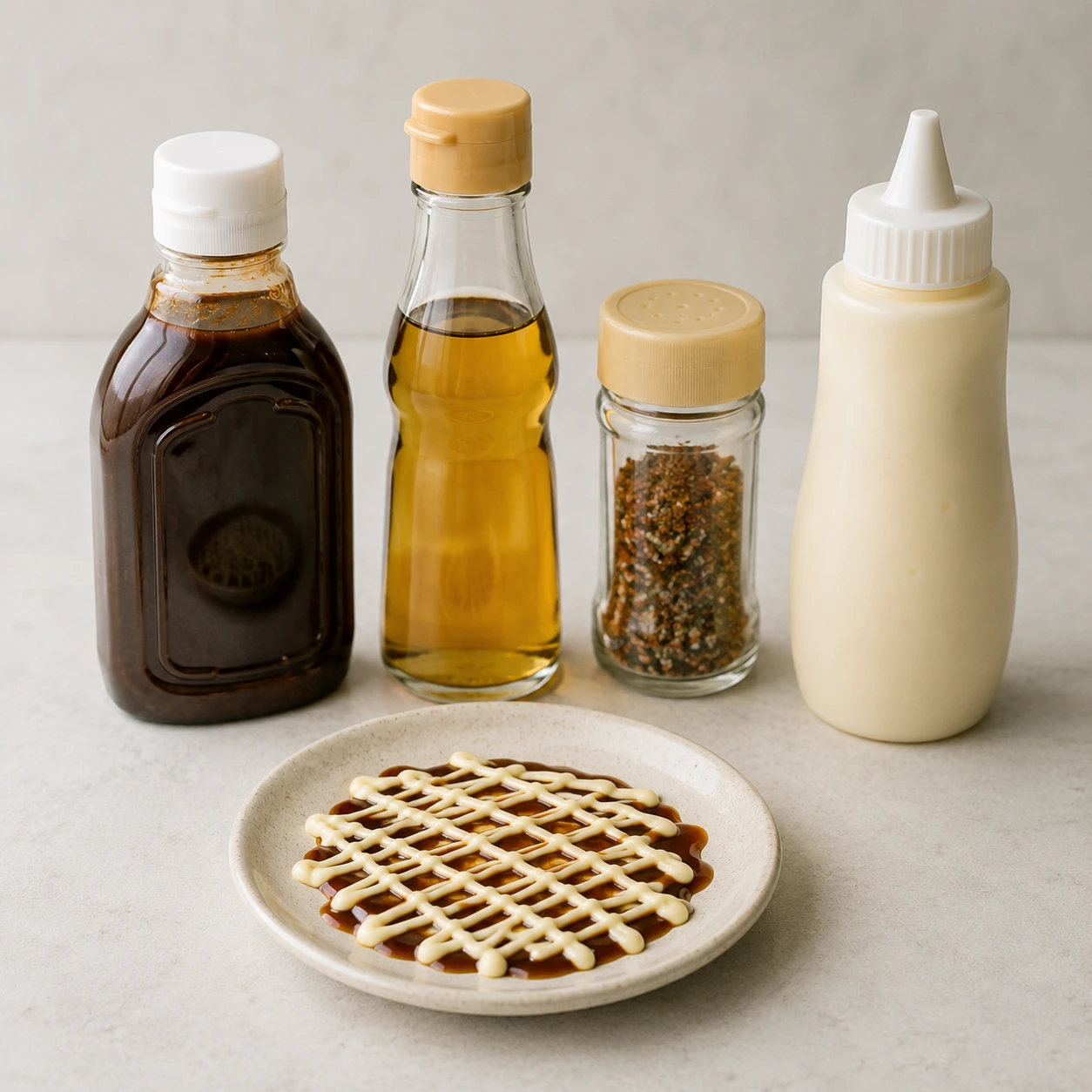
Okonomiyaki, Tonkatsu, Ponzu, Mayo: Japan's Table Sauces Explained
Four bottles cover most of what gets poured, drizzled and dipped in Japan. Here is what is in each one, how they differ from each other, and what to put them on.
There is a family of Japanese sauces that everyone recognises visually and almost nobody can tell apart on a shelf. Okonomiyaki sauce, tonkatsu sauce, chuno sauce, yakisoba sauce — all thick, all dark brown, all built on the same ancestor. Meanwhile Japanese mayonnaise sits next to them looking exactly like ordinary mayonnaise and tasting nothing like it.
They are worth untangling, because the differences are real and using the wrong one is the most common reason a home-made okonomiyaki tastes slightly off.
The brown sauce family: all descended from Worcestershire
Worcestershire sauce arrived in Japan in the Meiji era, was found too thin and too sharp for Japanese tastes, and got progressively thickened and sweetened with fruit and vegetable purée. What emerged is a family the Japanese call simply sōsu (ソース), graded by viscosity:
| Type | Thickness | Character |
|---|---|---|
| Usuta (ウスター) | Thin | Sharpest, most spice-forward |
| Chuno (中濃) | Medium | The all-purpose household bottle |
| Tonkatsu (とんかつ) | Thick | Sweeter, fruitier, clings |
| Okonomiyaki (お好み焼) | Thickest | Sweetest, most dashi-savoury |
They are all made from apple, tomato, onion, carrot, prune or date, vinegar, sugar, salt and spices. The differences are the ratio of fruit to vinegar and how far the purée is reduced.
Okonomiyaki sauce is the sweetest and thickest of the family, with added umami — usually oyster or dashi extract — because it has to stand up to a whole savoury pancake underneath it. Otafuku is the definitive brand; it is what the specialist restaurants in Osaka and Hiroshima use.
Tonkatsu sauce is slightly thinner and less sweet, with more vinegar bite — it needs to cut through deep-fried breaded pork rather than complement a soft pancake. Bull-Dog has been making it since 1902 and is the household default.
Can you substitute one for the other? Yes, and Japanese households do it constantly. Tonkatsu sauce on okonomiyaki is slightly sharper and less sweet than the real thing but perfectly good. Going the other way, okonomiyaki sauce on a cutlet can be cloying. If you buy one, buy okonomiyaki sauce for pancakes and tonkatsu sauce for everything else.
Ponzu: the citrus one, and the most useful bottle in the fridge
Ponzu is the outlier here — thin, sharp, and completely unrelated to the brown sauce family. It is soy sauce, rice vinegar, dashi and citrus juice, traditionally from yuzu, sudachi or kabosu rather than lemon.
The result is a sauce that is simultaneously salty, sour, savoury and aromatic, and it is genuinely one of the most versatile things you can own. In Japan it is the default dip for hot pot, the dressing for cold tofu, the finish for grilled fish, and the sauce for gyoza when someone wants something lighter than vinegar-and-soy.
Five uses if you have never bought it:
- Over cold silken tofu with spring onion and a little grated ginger.
- As a salad dressing, straight, with a few drops of sesame oil.
- Splashed over grilled or pan-fried salmon in the last seconds.
- As a dip for steamed or blanched greens.
- Mixed 1:1 with sesame oil as a marinade for chicken.
Note that "ponzu" strictly means the citrus juice alone; what you buy is almost always ponzu shoyu (citrus soy). The bottles say ponzu, and everyone means the soy version.
Japanese mayonnaise: why it tastes different
Japanese mayonnaise is not just a marketing distinction. Three real differences from a European or American jar:
- Egg yolks only, rather than whole eggs. That is why it is deeper yellow, richer and thicker.
- Rice vinegar rather than distilled vinegar, which is milder and slightly sweeter.
- A small amount of glutamate, which pushes it savoury in a way Western mayonnaise is not.
The packaging is functional too: the soft squeeze bottle with a star-shaped nozzle exists so you can pipe the fine lattice pattern that goes on okonomiyaki and takoyaki.
It is used far more widely in Japan than mayonnaise is in the West — on pizza, in potato salad, with corn, folded through tuna for onigiri filling, drizzled on grilled squid. If a dish is described as mayo something on a Japanese menu, that is not a joke.
Sesame dressing: the fourth bottle
The one that surprises people. Japanese sesame dressing (goma dare) is made from ground roasted sesame, rice vinegar, soy and mayonnaise-style emulsion — thick, nutty, faintly sweet, and the default dressing on salads in Japanese homes and restaurants alike.
It is also a shabu-shabu dipping sauce, a noodle sauce for cold udon, and — mixed with a little chilli oil — a genuinely good dip for cold chicken. Deep-roasted (深煎り) on the label means a darker roast and a stronger sesame note.
Chilli bean paste, for completeness
Not a table sauce but worth including, because it is the one jar that unlocks the Chinese-influenced side of Japanese home cooking. Doubanjiang is fermented broad bean and chilli paste, and it is the base of mapo tofu, mapo eggplant, and most of what Japanese households call chuka cooking.
Use it sparingly and always fry it in oil for thirty seconds before adding liquid — the flavour is fat-soluble and does not develop in water.
Which to buy first
- Cooking Japanese food regularly: ponzu. It is the most useful single bottle here by a wide margin.
- Making okonomiyaki or takoyaki: okonomiyaki sauce plus Japanese mayo. Those two are the dish.
- Making katsu: tonkatsu sauce, and nothing else will taste right.
- Salads and cold dishes: sesame dressing.
The rest of the foundational shelf — soy sauce, mirin, miso, dashi — is covered in the Japanese pantry starter kit.
Frequently asked questions
Do these need refrigerating? After opening, yes for all of them. Ponzu and mayonnaise in particular degrade noticeably at room temperature; the brown sauces are more robust but still keep better cold.
Is okonomiyaki sauce vegetarian? Usually not — most contain oyster extract or dashi made with bonito. Check the label if this matters; vegetarian versions exist in Japan.
Does Japanese mayonnaise contain MSG? Typically yes, as an added umami component. It is part of why it tastes the way it does.
Can I make okonomiyaki sauce at home? A workable approximation is 3 parts ketchup, 3 parts Worcestershire, 2 parts oyster sauce and 1 part sugar. It is close enough for an emergency and clearly not the same thing.
How long does an opened bottle last? Brown sauces, around three months refrigerated. Ponzu, one to two months before the citrus aroma fades. Mayonnaise, check the bottle — Japanese mayo generally carries a shorter opened life than Western jars.