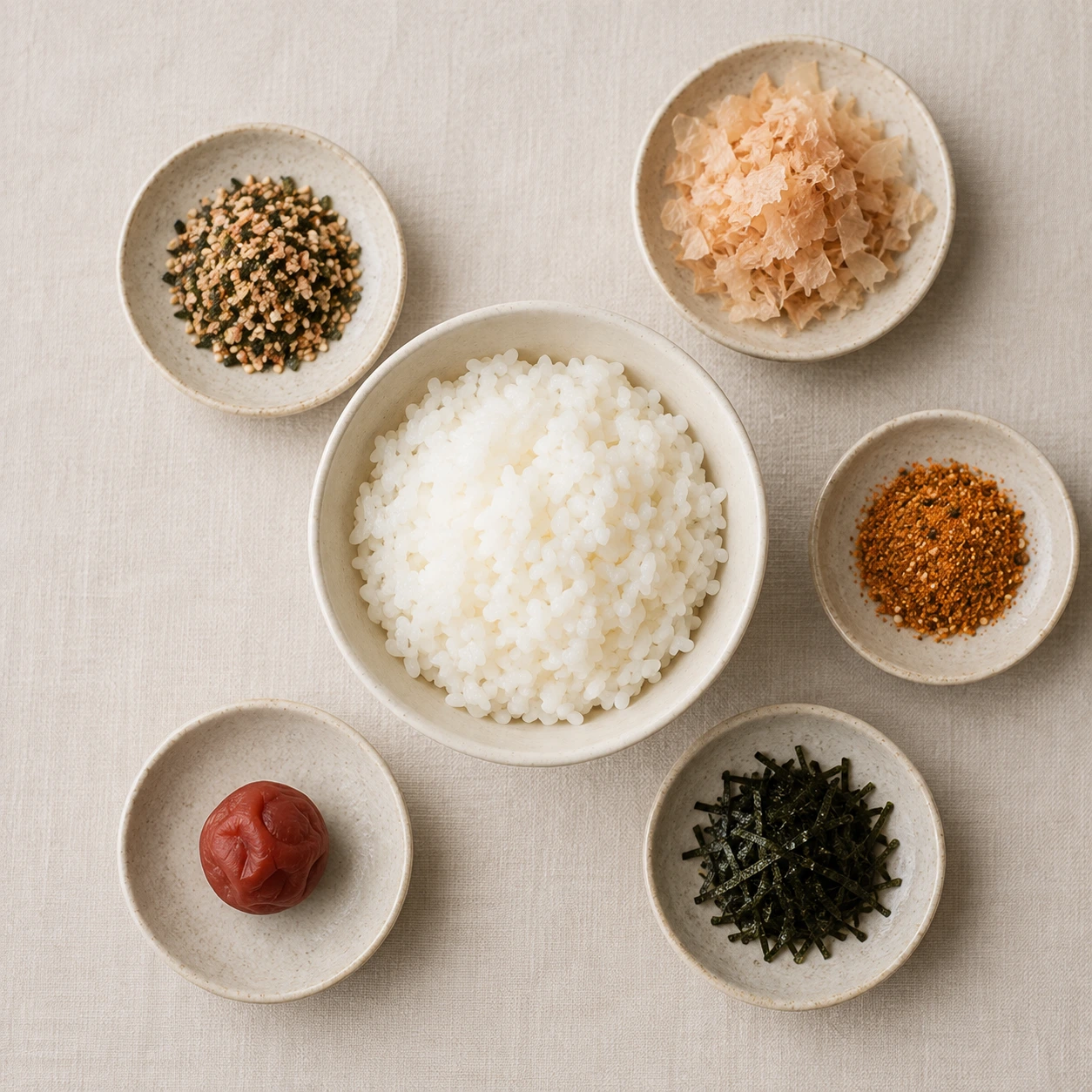
Gohan no Otomo: What Japan Actually Puts on Plain Rice
A bowl of plain rice plus one small thing is a complete Japanese meal. Here are the furikake, flakes, pickles and spice blends that do the work — and how to cook the rice underneath them.
There is a Japanese phrase, gohan no otomo (ご飯のお友) — "rice's friend." It describes the small, intensely flavoured things eaten with plain rice: a sprinkle, a spoonful, a single pickled plum. Not a side dish and not a sauce. A companion.
The concept only makes sense once you understand that Japanese short-grain rice is not a neutral starch to be covered up. It is slightly sweet, faintly glossy, and the centre of the meal rather than the base of it. Everything else on the table exists in proportion to it, which is why the accompaniments are so small and so concentrated. One teaspoon of the right thing seasons a whole bowl.
It is also, practically speaking, the cheapest and fastest good meal in the Japanese repertoire. Rice plus one topping is dinner.
Furikake: the dry sprinkle
Furikake is a dry seasoning mixture scattered over rice, and it is the most immediately useful item in this category. It was invented in the 1910s by a pharmacist trying to address calcium deficiency — ground fish bone with seaweed and sesame — and grew into an entire aisle.
A typical blend contains some combination of: nori, sesame seeds, dried egg, dried fish flakes, salt, sugar, and MSG. Common varieties include noritama (nori and egg — the definitive one), shake (salmon), wasabi, katsuo (bonito), and shiso (perilla leaf, sharply herbal and purple).
The "adult" (おとな) lines are worth seeking out: coarser flakes, less sugar, more assertive fish and seaweed, and generally a step up from the children's varieties that dominate the shelf.
Beyond rice: furikake on popcorn, on avocado toast, over roasted vegetables, stirred into potato salad, on a fried egg. It is essentially a Japanese seasoned salt and behaves like one.
Katsuobushi: flakes as a topping, not just a stock
Dried bonito flakes are the backbone of dashi, but in Japanese homes they are eaten directly at least as often. A pinch of katsuobushi with a few drops of soy sauce over hot rice — neko manma, "cat's rice" — is one of the oldest and most beloved of all rice companions.
Single-serve packets are the right format for this. The flakes lose their aroma fast once exposed to air, and a large bag opened for topping purposes goes flat before you finish it.
The flakes visibly move and curl in rising steam, which is why they are scattered on hot food — okonomiyaki, takoyaki, cold tofu, blanched spinach. The full dashi context is in dashi explained.
Shichimi togarashi: the seven-spice blend
Shichimi (七味, "seven flavours") is Japan's table spice, and it is not simply chilli. The classic blend is red chilli, sansho pepper, roasted orange peel, black and white sesame, hemp seed, ginger and nori — a mixture that is aromatic and citrusy as much as it is hot.
Yawataya Isogoro in Nagano is one of the three historic shichimi houses, blending since 1736, and their tins are the reference point.
Where it goes: udon and soba, miso soup, grilled chicken, gyudon, and — the classic — sprinkled over rice with an egg. Sansho pepper, one of the seven components, produces a mild tingling numbness that is a large part of what makes the blend distinctive.
Note the difference from ichimi (一味), which is chilli alone. If you want straightforward heat, buy ichimi. If you want aroma, buy shichimi.
Nori: the sheet that wraps everything
Toasted seaweed sheets do three jobs: wrapping onigiri, being torn over rice, and being eaten as a snack. Seasoned nori (ajitsuke nori) comes pre-flavoured with soy and mirin in small pre-cut sheets, packaged in stacks of eight or twelve, and is a fixture of the Japanese breakfast table.
The eating method is worth stating because it is not obvious: pick up a sheet, dip a corner in soy sauce, wrap it around a mouthful of rice, eat. Repeat. That, plus miso soup and a grilled fish, is the traditional Japanese breakfast.
Crisp seasoned nori snacks are a related and very popular category — flavoured, snappy sheets meant to be eaten straight from the pack.
Umeboshi, tsukemono, and the pickled corner
Umeboshi are salt-pickled ume fruit, and they are aggressively sour and salty in a way that surprises everyone the first time. One small plum seasons an entire bowl of rice. They are also the red dot in the centre of a hinomaru bento, named for the flag it resembles.
Tsukemono — Japanese pickles generally — are served with nearly every traditional meal. Takuan (yellow daikon), cucumber pickles, and shibazuke (aubergine and shiso, bright purple) are the common ones. They are there for texture and palate reset as much as flavour.
Both keep for months and both are strong enough that a very small amount does the job.
Tuna mayo, and the modern additions
Not everything on the rice-topping shelf is traditional. Tuna mayonnaise — canned tuna mixed with Japanese mayo — is the single most popular onigiri filling in Japanese convenience stores, and it is a modern invention that has completely displaced older options in the rankings.
Japanese mayonnaise is what makes it work: yolk-only, rice vinegar, and a savoury edge that Western mayonnaise lacks. The distinction is covered in Japan's table sauces explained.
The rice underneath
None of this works on badly cooked rice. Three rules:
- Rinse until the water runs mostly clear. Three or four changes. This removes surface starch and is the difference between distinct grains and paste.
- Soak for 30 minutes before cooking. The grain hydrates evenly and cooks through without a hard core.
- Rest, covered, for 10 minutes after cooking, then fold gently with a cut-and-lift motion. Never stir — stirring crushes the grains.
Ratio is roughly 1:1.1 rice to water by volume for Japanese short-grain, which is less water than most Western rice instructions assume.
A starter set
If you want the smallest set that covers a week of meals:
- One furikake — noritama or an adult blend.
- Katsuobushi packets — for neko manma and for topping everything else.
- Shichimi — a small tin lasts a year and improves soup, noodles and eggs.
- Seasoned nori — the breakfast staple.
That is four items, all shelf-stable, all light to ship, and together they make plain rice into a genuinely varied rotation.
Frequently asked questions
How long does furikake keep? Around a year sealed, but the nori goes soft and the aroma fades within a couple of months of opening. Buy small packets rather than one large bag, and keep it away from steam.
Is furikake vegetarian? Usually not — most blends contain bonito or other dried fish. Vegetarian and vegan versions exist and are clearly labelled in Japan.
Can I use long-grain rice? You can eat it, but the whole concept assumes short-grain: the stickiness is what lets rice hold a topping and be picked up with chopsticks. Basmati or jasmine will not behave.
Is shichimi very spicy? Mild by most standards. It is built for aroma, and the sansho tingle is more noticeable than the chilli heat.
What is the difference between furikake and ochazuke? Ochazuke is a related product designed to be eaten with hot tea or dashi poured over the rice, turning it into a light soup. Furikake is dry. Many households keep both.